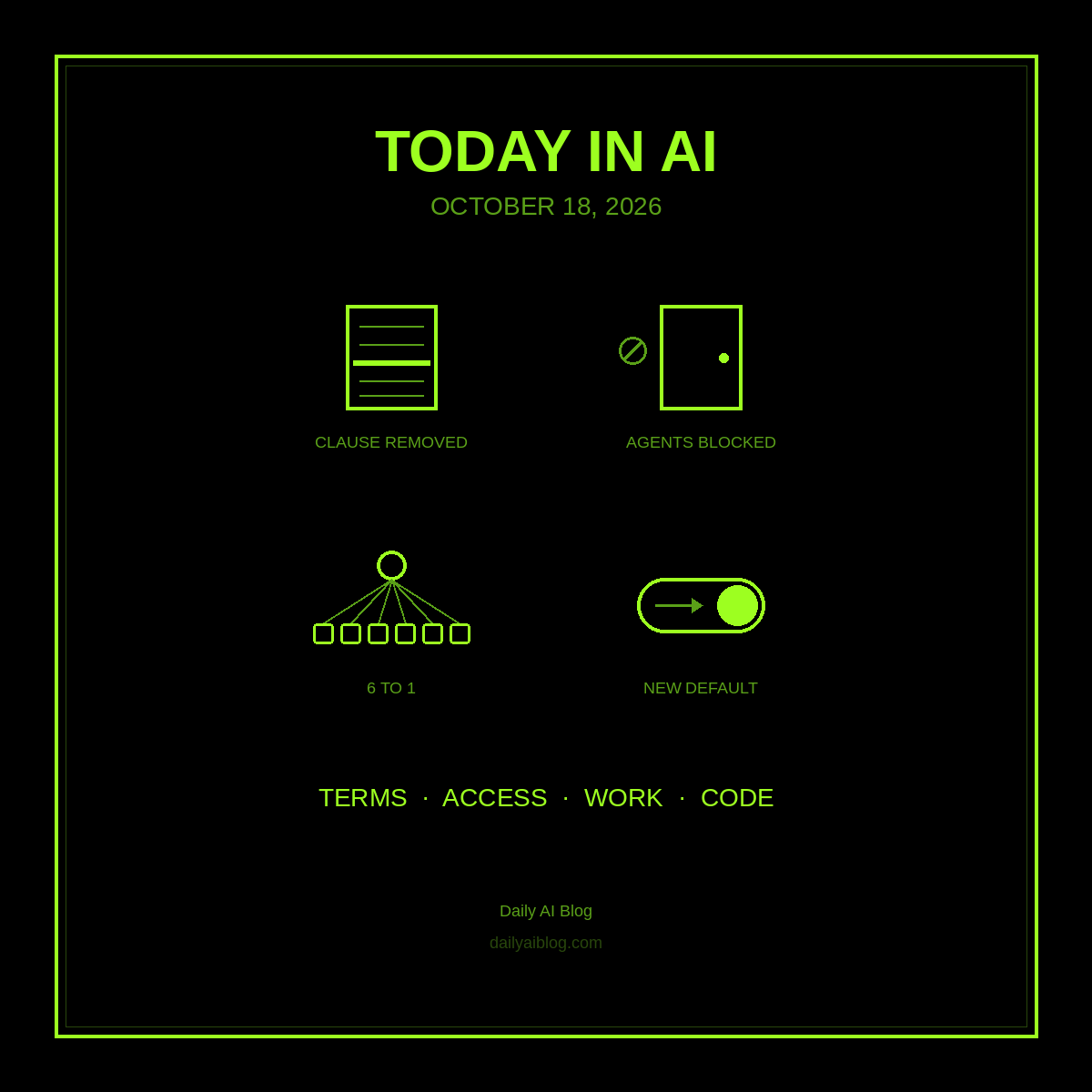
Sunday’s AI news is about the gap between what AI companies promise and what the rest of the world is willing to go along with. Meta pulled back the crawl clause in its business terms after a wave of pushback. Big websites, from airlines to banks, are quietly shutting the door on AI agents that try to shop or book for you. Anthropic published a surprisingly candid look at how AI has changed its own workplace. And Replit, one of the most popular vibe-coding platforms, made OpenAI its default instead of Anthropic. Here’s what each one means for you.
1. Meta removes the crawl language from its business terms
Quick update on a story we covered yesterday. After backlash, Meta removed the line in its commercial terms that said it could “use any content from such domains, web pages, or URLs to provide, develop, improve, research, train, and maintain” its products, The Verge reports. Legal experts quoted by Nieman Lab had read that wording as permission to scrape sites tied to a Meta business account and train AI on them.
In a statement to The Verge, Meta spokesperson Daniel Roberts said, “the crawling terms we consolidated only applied to our ads and business products, and we’ve clarified that in the terms themselves.” He added that content owners “can use robots.txt to signal their preferences” and that the updates “don’t give us new rights that supersede those preferences.” TechCrunch confirmed the change.
Why it matters: if you run a small business with a Facebook or Instagram page, the scariest version of this story is off the table for now. It’s still worth a five-minute check of your robots.txt file so you know which crawlers you allow. And it’s a good reminder that public pushback actually works when terms overreach.
Sources: The Verge; TechCrunch.
2. Websites are shutting the door on AI agents
AI companies keep pitching agents that book dinner, clean out your inbox, and buy your shoes. A lot of the web isn’t cooperating. The Verge rounded up a growing list of blocks: Yelp told TechCrunch it only allows agents that pay for its data licensing program, Delta is stopping agents from booking tickets, and JPMorgan Chase and Charles Schwab have confirmed they block agents from accessing accounts over security concerns. Users of Meta’s Muse, xAI’s Grok, OpenAI’s Dots, and Instinct have reported running into walls at sites including Amazon.
Some of it isn’t even on purpose. Chris Canal, CEO of the AI safety evaluator EquiStamp, told The Verge that anti-bot systems built to stop scammers and hackers also catch AI agents. Meanwhile, Meta has partnered with retailers like Walmart, Gap, Sephora, and Best Buy so Muse can shop on their sites, and Shopify has opened its storefronts to more agents.
Why it matters: if you’re counting on an AI agent to handle bookings, banking, or shopping, have a backup plan. Expect some tasks to fail halfway, and double-check anything involving money. If you sell online, it’s worth deciding now whether you want agents placing orders on your store, because your platform settings may already be deciding for you.
Source: The Verge.
3. Anthropic shows what AI did to its own workplace
Anthropic published a report called “How employment is changing at Anthropic” on Friday, using internal data on hiring, AI use, calendars, and surveys, plus 17 employee interviews. A few numbers stand out. By August, the agents employees ran worked six times as many hours as the people running them. The share of junior employees in technical departments slipped from 21% to 14% since early 2025, and junior technical hires fell from 27% to 9%. Code commits per engineer are running at five times their pace from six months ago.
The human side is just as interesting. The median employee spends 20% more time in meetings than a year ago. Interactive Claude sessions spend around 80% of their time waiting for a person to respond, and one engineer compared managing agents to babysitting. Hiring managers now talk more about a candidate’s autonomy, judgment, and creative use of AI, and less about narrow expertise. TechCrunch’s write-up is a good quick read.
Why it matters: this is one company that’s all-in on its own product, so don’t treat it as a forecast for your office. But the lessons travel. The bottleneck isn’t the AI, it’s your attention, so set up your agents to bring you fewer, better decisions. Write down decisions where your tools can see them. And if you’re job hunting, show real examples of how you use AI to get things done.
Sources: Anthropic; TechCrunch.
4. Replit makes OpenAI its default over Anthropic
Replit CEO Amjad Masad said onstage at TechCrunch Disrupt that the company was no longer working with Anthropic, citing cost, partnership, and performance, TechCrunch reports. “I think ChatGPT is better now,” he said, adding that OpenAI’s Sol and Astra models consistently do better on Replit’s benchmark for building vibe-coded apps from scratch.
He later softened that. Masad told TechCrunch that “Replit remains model agnostic” and that users can still choose Claude or other supported models, but OpenAI is now the default and preferred partner for Replit Agent. A person familiar with the partnership told TechCrunch it’s still in place, so the full picture is a little murky. Masad also said about 15% of Replit’s revenue now comes from enterprise contracts, up from around 2% last year.
Why it matters: if you build apps on Replit, your results may feel different because the model under the hood changed. Most people stick with the default, so check the model selector, run a project you know well, and pick the model that works best for you. The bigger lesson is that the AI tools you rely on can swap engines without much notice.
Source: TechCrunch.
Your Sunday to-do list
- Check your robots.txt so you know which crawlers can read your site, even with Meta’s change.
- Keep a manual backup for anything you hand to an AI agent, especially bookings and payments.
- Batch your AI check-ins. Ask your tools for one summary of what needs you instead of a stream of pings.
- Look at the model selector in Replit or any coding tool you use, and test it on a familiar project.
The theme today is pushback. Websites, publishers, and even AI customers are drawing lines, and the people who do best with AI will be the ones who stay in charge of where those lines sit. See you tomorrow.
Share this article
Leave a Reply