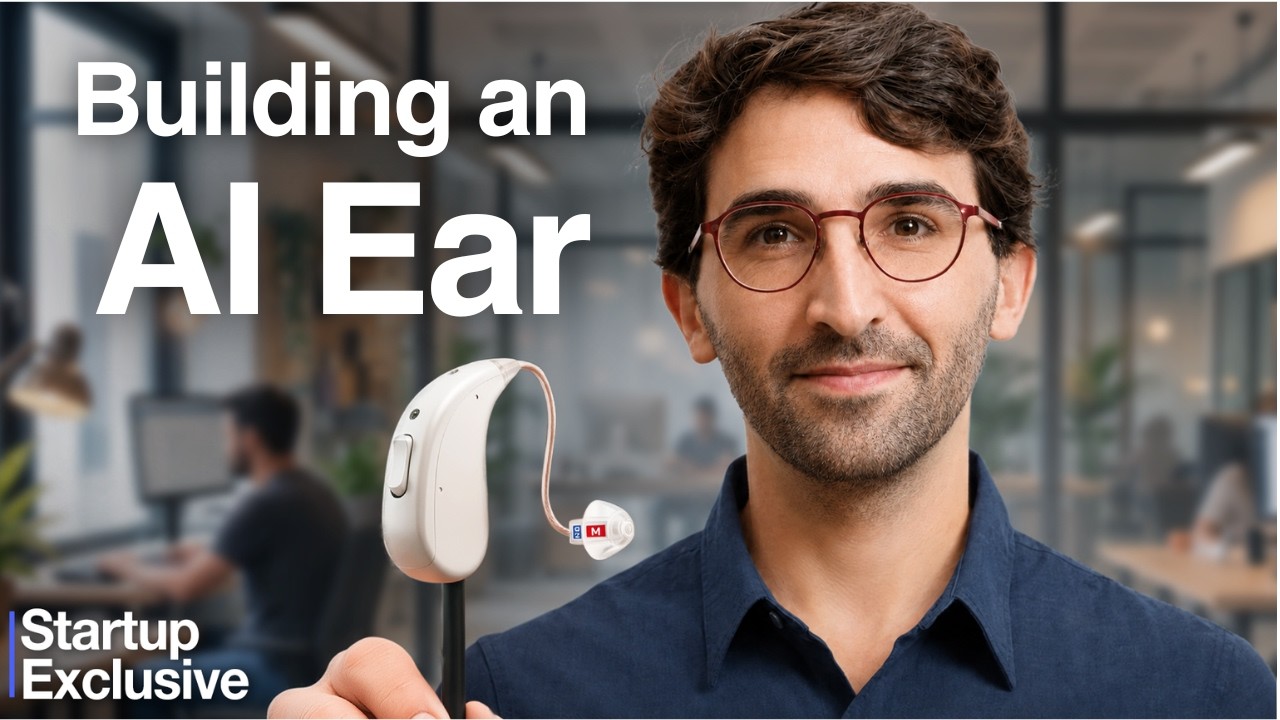
Sachin and Adam spent 17 minutes inside Fortell, the New York startup building AI hearing aids that people with severe hearing loss have been waiting decades for. The video is a factory-and-clinic walkthrough, not a product ad. The moment that lands is simple: press a button, look at the person you want to hear, and everyone else drops away.
Watch the original here:
The problem hearing aids still fail at
About one in five people worldwide have some hearing loss. That’s on the order of 1.5 billion people. Fortell’s researchers note it’s been stubbornly flat in the global disease-burden stats even as other conditions improved. Hearing loss is also linked with dementia, which is why this isn’t just a gadget story.
Traditional hearing aids mostly make the world louder. The thing people actually need, especially in a cafe or a cocktail party, is selective loudness: speech in front of you up, everything else down. For 30 years the big hearing-aid companies couldn’t show that computers could do that in a device that fits behind an ear. Fortell’s bet was that a giant AI model, running on custom silicon, finally could.

It started as a ridiculous pair of headphones
Cofounder Igor Lovchinsky, who leads the algorithms, walked them through the first test rig. Off-the-shelf headphones with microphones glued onto the ear cups, wired into boxes, then into a laptop. They called it Medusa. All the AI lived on the computer. They spent two years on that science problem before they had any right to build a hearing aid.
That same laptop-and-headset stack is what they took to Founders Fund for the Series A. Founders Fund didn’t mention it at the time, but they’d invited a friend with severe hearing loss. He took out his own aids, put Medusa on, and said: “I would mortgage my house for this.” They led the round.
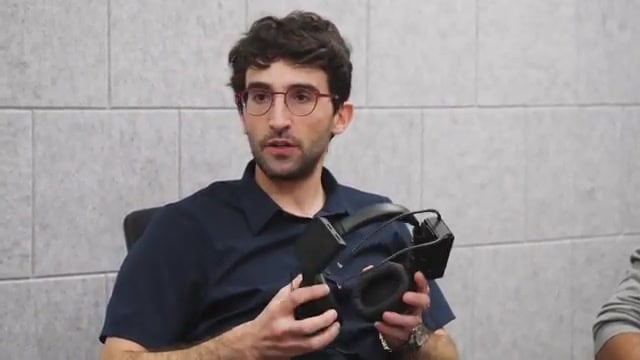
The Zoom-era insight that unlocked it: video-call noise suppression started telling speech from typing, kids, and AC units by what the sound is, not which frequencies it occupies. Cofounder and CEO Matthew de Jonge has said he had that aha in a meeting when he watched a colleague type and couldn’t hear the keys. If telephony could do it, maybe a hearing aid could too. The question was whether it would fit in a tiny package on an ear, all day, with no laptop.
“Inject the magic”
Andrew Casper, the hardware cofounder (Butterfly Network’s custom ultrasound chip, then Google), showed the manufacturing line. Devices get assembled, then the chips get programmed. Out of the line a unit is just a test program: “I’m working.” After they flash the custom firmware and model, it’s a hearing aid. That’s what they mean by injecting the magic.
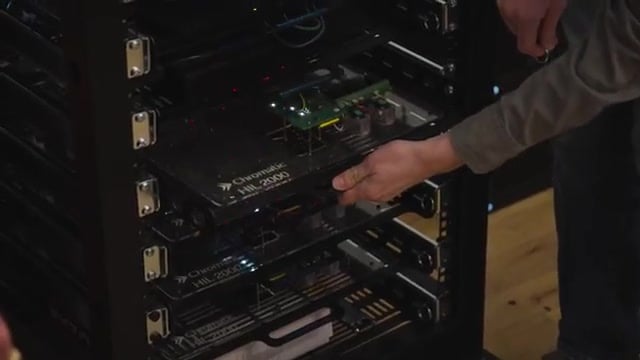
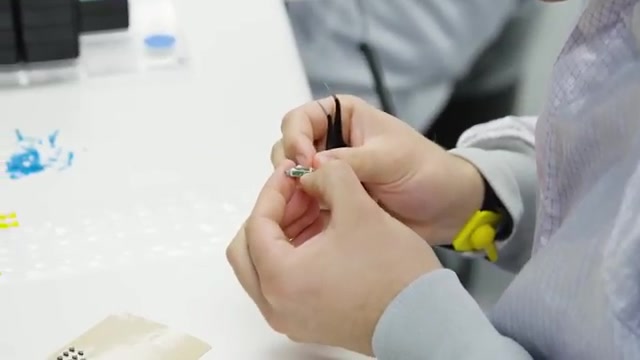
The first time the custom chip came back and actually worked, de Jonge wore it to a noisy restaurant. He called it the single biggest de-risking moment of the company’s five years: the AI problem, the chip problem, and the integration, all proven in one night. Going from “it works on a bench” to “it is polished and reliable for someone who needs it every day” is the part they still treat as humblingly hard.
The demo: hear where you look
At the Park Avenue clinic they ran the hosts through a real patient flow. Soundproof booth, beeps at different frequencies, word lists, then sentences in background noise. That audiogram tells the aid how loud to make sounds for your ear.
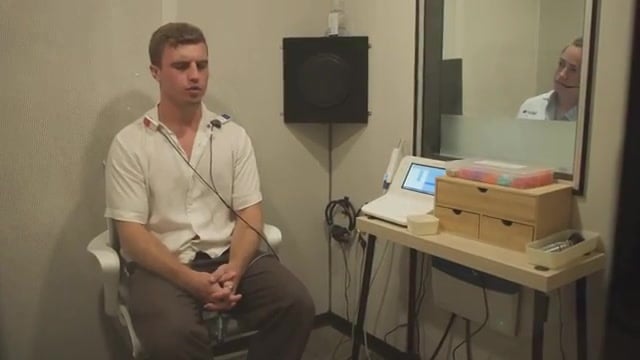
Then the part the title of the video is selling. An audiologist stands behind you counting. You hear her loud. They turn on AI, “front voices only.” She falls off. The host in front of you starts the ABCs. You rotate toward the counter, and her voice comes back; rotate back, and the ABCs win. The device is using where you look as the cue for whose voice to keep.
In the noisiest restaurants, that’s the button they recommend. Not louder. Just the people you’re actually talking to.
The company, in one paragraph
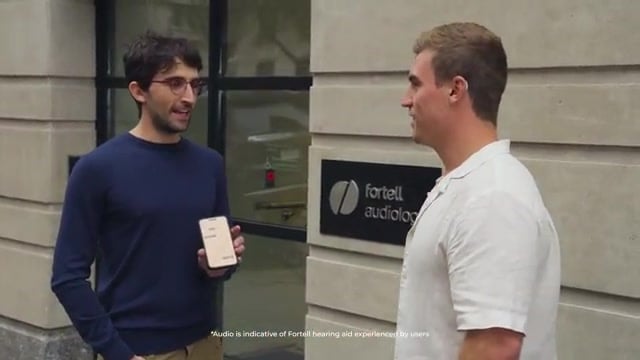
Fortell launched the product in December. Forbes put it on the 2026 Next Billion-Dollar Startups list after a $163 million raise at about a $740 million valuation, with Founders Fund, Thrive Capital, and Valor Equity Partners in the round. A pair currently runs about $6,800, prescription-only, fit by Fortell’s own audiologists. Public names who’ve bought in include KKR’s Henry Kravis and Steve Martin. Clinics are open in Manhattan (530 Park Ave), Greenwich, CT, and Palm Beach, with Boston on the way. de Jonge has said the bottleneck is hiring audiologists, not demand, and that this should not stay a status symbol.
On Fortell’s own site they claim 10x more words understood versus the leading AI hearing aid in hard noise, up to a 17 dB SNR improvement, 95% of trial participants preferring Fortell over five top-spec competitors, and up to 98% of background noise removed. Those are company-reported trial numbers. Watch the video if you want the human version of the same pitch.
Why this is the post
Most “AI hardware” launches are a chat app in a new shell. This one is a custom model on custom silicon, in a regulated medical device, aimed at a problem that has been stuck for a generation. If the look-where-you-look demo holds up outside a controlled clinic, Fortell didn’t just ship a nicer hearing aid. They shipped a new interface for attention.
Full tour: Why Billionaires & Celebrities Are Lining Up for This $700M AI Startup (Sachin and Adam). Company site: fortell.com.
Share this article
Leave a Reply