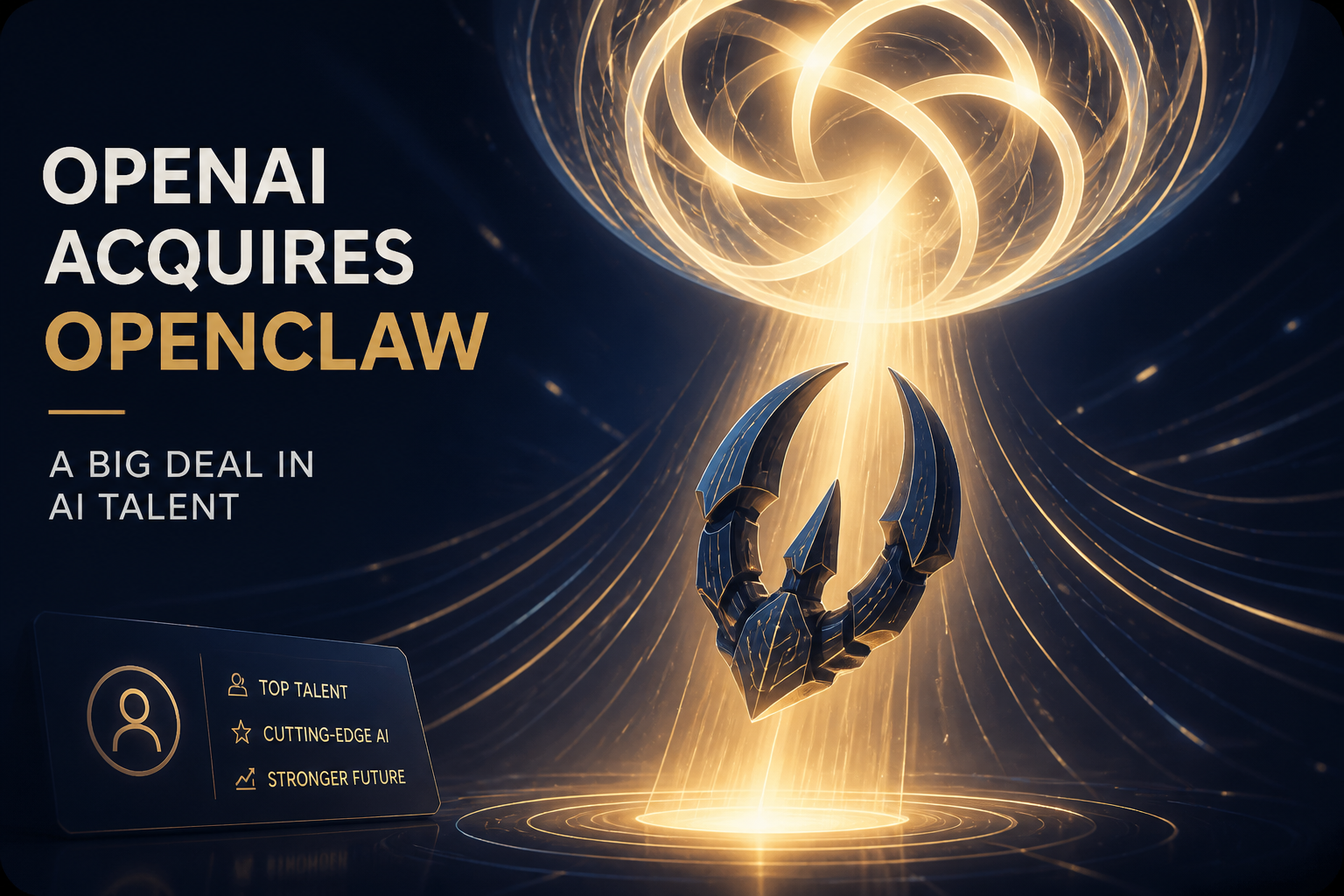
Sam Altman just poached the creator of the most viral AI project on the planet — and the story of how we got here is absolutely wild. On February 15, 2026, OpenAI announced that Peter Steinberger, the Austrian developer behind the open-source AI agent framework OpenClaw, is joining the company to lead its “next generation of personal agents.” It’s the clearest signal yet that the AI wars have shifted from chatbots to agents that actually do things.
From WhatsApp Hack to 198,000 GitHub Stars
If you haven’t been following the OpenClaw saga, buckle up. Back in November 2025, Steinberger — a semi-retired founder who’d previously built PDF toolkit PSPDFKit into a business used by Apple, Dropbox, and IBM — was traveling in Marrakesh when he “hacked together some WhatsApp integration” in about an hour. That side project, originally called Clawdbot, let an AI agent manage his email, calendar, and web browsing through simple chat messages.
It exploded. Within weeks, Clawdbot had tens of thousands of GitHub stars and a passionate community building plugins for everything from flight booking to Discord moderation. Then Anthropic sent a trademark cease-and-desist — the name was too close to “Claude.” Steinberger renamed it Moltbot, then quickly to OpenClaw. Far from killing momentum, the drama only amplified it. By mid-February 2026, OpenClaw had 198,000 GitHub stars, 20,000+ forks, and 2 million weekly visitors.
A Billion-Dollar Bidding War Over a Money-Losing Project
Here’s the part that makes your head spin: at the time of the deal, OpenClaw was losing $10,000–$20,000 per month. Steinberger was routing all sponsorship revenue to the project’s dependencies rather than pocketing it himself.
That didn’t stop Big Tech from throwing money at it. According to Engadget, both Meta and OpenAI made offers reportedly “in the billions.” Mark Zuckerberg personally reached out via WhatsApp. Microsoft CEO Satya Nadella expressed interest too. The pitch from Meta was about “agentic commerce” — using OpenClaw as infrastructure for AI agents that could transact on behalf of users across Meta’s platforms.
Steinberger chose OpenAI, but with conditions. “My conditions are that the project stays open source,” he told reporters, comparing his preferred model to the Chrome/Chromium relationship. OpenClaw will move to an independent open-source foundation with ongoing OpenAI support, and the MIT license stays intact.
Why OpenAI Wants the Agent Whisperer
Altman didn’t mince words about why he wanted Steinberger: “He is a genius with amazing ideas about the future of very smart agents interacting with each other.” The OpenAI CEO added that “the future is going to be extremely multi-agent,” positioning this hire as central to OpenAI’s next chapter.
OpenClaw represents exactly the product vision OpenAI is chasing. It’s not just another chatbot — it runs locally on your hardware, connects to your messaging apps (WhatsApp, Telegram, Discord, iMessage), and autonomously executes real-world tasks. It writes code, coordinates with other agents, breaks complex goals into sub-tasks, and actually follows through. Steinberger once described these agents as “damn smart, resourceful beasts if you actually give them the power.”
With this hire, OpenAI gets a leader who’s proven he can build agent products people actually want to use — plus serious credibility with the open-source community that has been skeptical of OpenAI’s increasingly closed approach.
The Elephant in the Room: Security
Not everyone is celebrating. Gartner rated OpenClaw an “unacceptable cybersecurity risk” and recommended businesses immediately block downloads and related traffic. The numbers are alarming: over 135,000 instances exposed to the internet, 93% with critical authentication bypass vulnerabilities, and a CVE (CVE-2026-25253, CVSS 8.8) allowing remote code execution through a malicious link.
Security researcher Maor Dayan called it “the largest security incident in sovereign AI history.” Plaintext credential storage, backdoored plugins circulating in the wild, and prompt injection attacks are all documented issues. Perhaps most concerning: 53% of enterprise customers at one security firm gave OpenClaw privileged access over a single weekend, before any security review.
This is the fundamental tension of agentic AI. The more capable an agent is — the more it can actually do — the more dangerous it becomes when compromised. OpenClaw has since integrated VirusTotal malware scanning, but the security community remains on high alert.
What This Means for the AI Agent Race
The OpenClaw acqui-hire is a milestone moment. It confirms that the next phase of the AI industry isn’t about who has the best language model — it’s about who can build agents that reliably act on your behalf in the real world.
The competition is fierce. Meta wants agents for commerce. Google is building agents into its ecosystem. Apple is expected to follow. And the market is enormous — AI agents are projected to be a $180 billion market by 2033, growing at nearly 50% annually.
Meanwhile, the skeptics aren’t wrong to pump the brakes. Some AI researchers told TechCrunch that OpenClaw is “nothing novel” from a technical standpoint — it repackages existing agentic techniques rather than breaking new ground. But as Steinberger might argue, the magic isn’t in any single technique. It’s in making agents that regular people actually want to use.
The Bottom Line
Peter Steinberger went from hacking together a WhatsApp bot in Morocco to fielding billion-dollar offers from Zuckerberg and Altman — in under three months. His creation, OpenClaw, proved that people are ready for AI that doesn’t just talk but actually gets things done. Now at OpenAI, he’ll have the resources to take that vision much further.
Whether the security concerns get resolved, whether the open-source community stays engaged, and whether agents can be trusted with real-world actions at scale — those are the questions that will define 2026 in AI. One thing’s clear: the age of the AI agent has officially arrived.
Videos on the topic
Sources: TechCrunch, CNBC, Engadget, SiliconANGLE, VentureBeat, Gartner
Share this article
Leave a Reply