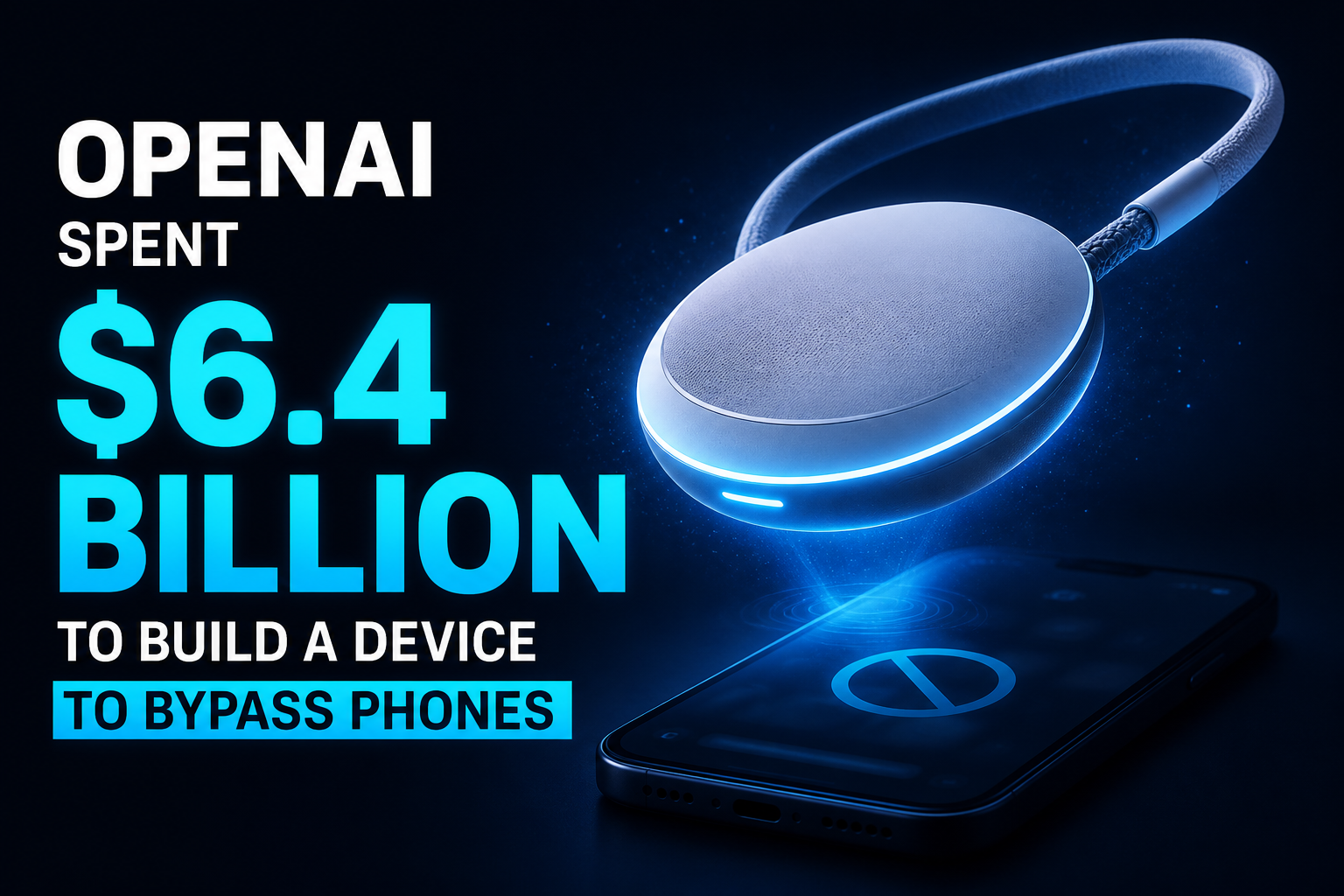
OpenAI spent $6.4 billion to acquire the team that designed the iPhone. Now they’re building a device that could make the iPhone feel outdated. But court filings from February 10, 2026 just revealed a major setback — and the road ahead looks rockier than anyone expected.
Here’s everything we know about OpenAI’s most ambitious project yet.
The $6.4 Billion Bet
In May 2025, OpenAI acquired io Products — a startup founded by Jony Ive, the legendary designer behind the iPhone, iPod, iMac, and pretty much every iconic Apple product of the last two decades. The price tag: $6.4 billion in equity.
Ive didn’t come alone. He brought three former Apple colleagues:
- Scott Cannon — previously led teams on Mac and iPad development
- Evans Hankey — Ive’s successor as head of design at Apple
- Tang Tan — led iPhone design for years
That’s essentially Apple’s former design brain trust, now working for Sam Altman. About 55 engineers and product specialists joined OpenAI in the deal. Laurene Powell Jobs (Steve Jobs’ widow) is also involved as an investor and advisor through her Emerson Collective.
What They’re Building
OpenAI is developing multiple device form factors, but two have emerged from leaks:
“Sweetpea” / “Dime” — AI Earbuds: Behind-the-ear earbuds with detachable pill-shaped modules. Powered by a Samsung 2nm Exynos chip for on-device AI processing, with cloud support for heavier tasks. This appears to be the first product headed to market.
“Gumdrop” — A Pen-Shaped Device: An iPod Shuffle-sized device with no screen, equipped with cameras, microphones, and sensor arrays for contextual awareness. Can run OpenAI models locally.
Important caveat: OpenAI executives have called some of these specific leak details “fake news.” One exec said the prototype is “neither an in-ear device nor a wearable.” The final form factor may still be in flux.
What we do know: Foxconn has been asked to prepare for 5 total devices launching by Q4 2028. This isn’t a one-off experiment — it’s an entire hardware platform.
The Vision: AI Without a Screen
The pitch isn’t “a better phone.” It’s something fundamentally different.
Sam Altman describes the experience as the difference between “sitting in the most beautiful cabin by a lake” versus the chaos of Times Square. Smartphones are Times Square — notifications, scrolling, dopamine loops. The OpenAI device is supposed to be the cabin.
Jony Ive put it this way:
“I love solutions that teeter on appearing almost naive in their simplicity. Incredibly intelligent, sophisticated products that you want to touch, and you feel no intimidation, and you want to use almost carelessly — that you use them almost without thought — that they’re just tools.”
When asked what people would say when they see it, Altman teased: “That’s it? It’s so simple.”
The concept is ambient computing — AI that blends invisibly into your life instead of demanding your attention through a screen. A “third core computing platform” alongside phones and laptops. Not a replacement, but something entirely new.
The Delay Nobody Saw Coming
Here’s where the story takes a turn.
As recently as January 2026, OpenAI’s Chief Global Affairs Officer confirmed at Davos that the device would debut in the second half of 2026. The sales target was wildly ambitious: 40-50 million units in year one.
Then, on February 10, 2026, court filings revealed two major problems:
- The device won’t ship before February 2027 at the earliest. No packaging or marketing materials have been created yet.
- The “io” brand name has been dropped due to a trademark lawsuit from an audio startup called iyO.
A product with no name, no packaging, no marketing materials, and a pushed-back launch date — that’s a significant gap between the vision and the execution.
The Graveyard of AI Hardware
OpenAI isn’t the first company to try this. The track record is brutal:
Humane AI Pin (Failed): Launched at $699 plus $24/month. Plagued by 2-4 hour battery life, slow response times, and hallucinations. Couldn’t do anything a phone couldn’t do better. Sold to HP for just $116 million — a fraction of its investment.
Rabbit R1 (Struggled): $199 handheld with a “Large Action Model” for task automation. Suffered from limited functionality and reliability issues. Became more of a curiosity than a useful product.
Meta Ray-Ban Smart Glasses (Succeeded): Over 2 million units sold, with sales tripling year-over-year. Priced at $299-499. The key difference? They partnered with an established fashion brand, used a familiar form factor (glasses people already wear), and didn’t try to replace the phone.
Why OpenAI Thinks It’s Different
The counterargument is strong:
- The AI is dramatically better. Humane and Rabbit launched with mediocre AI models. OpenAI has GPT-5 and the world’s most recognized consumer AI brand (ChatGPT).
- The design team is unmatched. Jony Ive literally invented modern consumer hardware design. The io team designed the iPhone, iPad, and Mac.
- The money is unprecedented. $6.4 billion for the acquisition alone. The 5-device roadmap through 2028 suggests this is a long-term platform play, not a side project.
- Simpler-first strategy. Instead of trying to replace the phone on day one, they’re starting with earbuds — a form factor people already understand and use.
But there’s a nagging question: if the best hardware designer alive and the most powerful AI company on earth still can’t ship on time, how hard is this problem really?
What This Means for You
Whether or not the OpenAI device succeeds, the direction is clear: the tech industry is betting that the future of AI isn’t on a screen.
Meta’s glasses are selling. Apple is working on AI-powered wearables. Google has Android XR. And now OpenAI is throwing $6.4 billion at the problem. The race for what comes after the smartphone is officially on.
Keep your eyes on:
- The rebrand — what will the device be called now that “io” is dead?
- The 2027 launch window — will it slip further?
- Pricing — with a 40-50 million unit target, aggressive pricing (likely subsidized) seems likely
- Meta’s next move — their Ray-Ban glasses are the only AI hardware success story so far
Sam Altman is betting that the smartphone era has peaked. Jony Ive is betting his legacy on it. And $6.4 billion says they’re serious. Whether that’s visionary or reckless — we’ll find out in 2027.
Sources: CNBC, TechCrunch, 9to5Mac, Axios, MacRumors, Tom’s Guide
Share this article
Leave a Reply