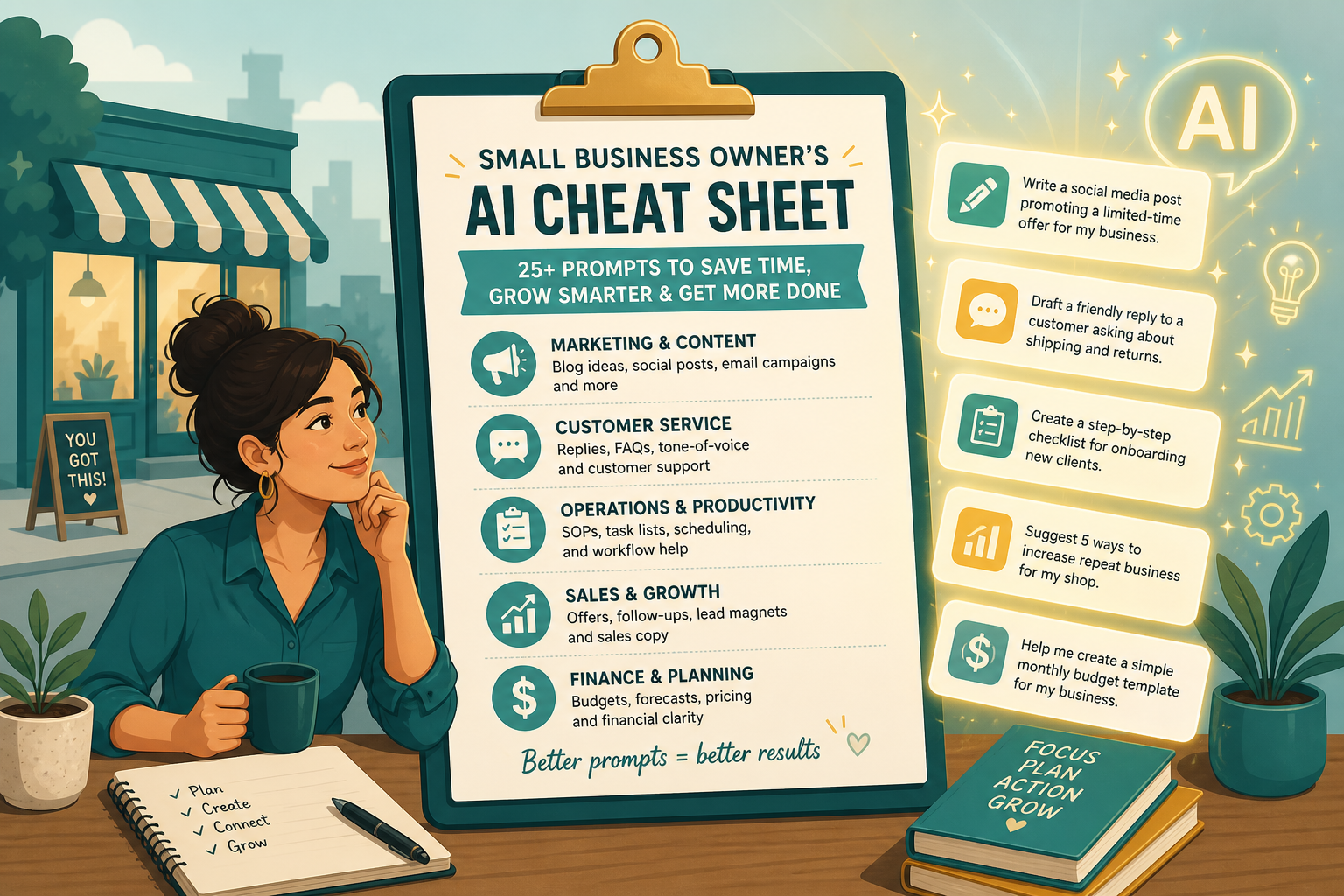
If you’ve tried ChatGPT and thought “this is useless,” the problem isn’t the tool — it’s how you’re talking to it. Generic prompts produce generic garbage. But with the right instructions, AI becomes the hardest-working employee you’ve never had to hire. Here are 25+ copy-and-paste prompts organized by business function, plus a dead-simple framework for writing your own.
Why Most AI Prompts Fail (And the Fix)
According to HubSpot’s State of AI Report, 66% of marketers now use AI daily, with 88% choosing ChatGPT as their go-to tool. But here’s the gap: most people type something vague like “write me a marketing email” and wonder why the output reads like a robot wrote it.
The fix is a framework I call CREST:
- C — Context: Tell the AI who you are, what your business does, and who your audience is
- R — Role: Assign a persona (“Act as a senior marketing strategist with 15 years of e-commerce experience”)
- E — Examples: Paste in your brand voice, previous copy you liked, or competitor examples
- S — Specifics: State the exact format, length, tone, platform, and constraints
- T — Tweak: Never accept the first output. Iterate 2-3 times until it nails your voice
Keep CREST in mind as you use the prompts below. Each one already has the structure built in — you just need to fill in the brackets with your details.
Marketing & SEO Prompts
Generate blog topic ideas:
“Generate 10 blog ideas for [your product/niche] for [your target audience] at different stages of their buyer journey. For each idea, include the content angle, who it’s for, and suggested keywords.”
SEO landing page copy:
“Generate SEO-optimized copy for a landing page marketing [your product]. The primary keyword is ‘[keyword].’ Emphasize the product’s unique selling points: [list 2-3 USPs]. Include a clear call to action.”
Marketing strategy research:
“Act as a business consultant with deep experience in [your industry]. What are the most common pain points for customers in [your niche] at each stage of the buying process? Suggest content angles and strategies that address each pain point.”
Email Marketing Prompts
Welcome email sequence:
“Outline a 5-email welcome sequence for new subscribers who downloaded [your lead magnet]. For each email, include: subject line, main message, and call to action. Use a value-driven approach.”
Re-engagement campaign:
“Draft a re-engagement email for subscribers who haven’t opened our emails in the past month. Write a curiosity-driven subject line. Our business is [describe business] and our audience cares about [topics].”
Subject line generator:
“Suggest 10 subject lines for a [seasonal/promotional] email campaign for [your product]. Include a mix of curiosity-driven, benefit-focused, and urgency-based approaches. Keep each under 50 characters.”
Social Media Prompts
Instagram caption:
“Write an Instagram caption promoting our [product/event/offer]. Keep it under 125 characters. Focus on [key benefit]. Tone: [lighthearted/professional/inspiring]. Include a clear call to action.”
LinkedIn thought leadership:
“Write a 150-word LinkedIn post based on [topic/article]. Highlight 3 key insights and pose a thought-provoking question to encourage discussion. Balance professionalism with approachability.”
2-week content calendar:
“Create a 2-week social media calendar based on these content pillars: [list your pillars] for [your business]. Analyze which platforms will give us the most traction to achieve [your goal]. Include post ideas with suggested formats.”
Repurpose content:
“Repurpose this blog post into 10 LinkedIn posts. Vary the format: story-driven, data-focused, question-based, controversial take, how-to. Each should have a key takeaway for [your target audience].”
Customer Service Prompts
Respond to a complaint:
“Write a polite, empathetic customer service email responding to a customer who [describe the issue]. Explain that we will [resolution]. Thank the customer for their patience. Use professional but warm language.”
Difficult customer script:
“Write a customer service script for dealing with difficult customers. Include conflict de-escalation techniques. My business is [describe business] and our policy on [relevant policy] is [details].”
FAQ generator:
“Generate 10 frequently asked questions that customers of a [your type of business] would commonly ask. For each, provide a clear, concise answer in 2-3 sentences.”
Content Creation Prompts
Blog post with a strong hook:
“Write an 800-word blog post about [topic] for [describe audience]. Start with a compelling hook. Use conversational language with authority. Include 3-5 H2 subheadings, practical takeaways, and a conclusion with a call to action.”
Product descriptions:
“Write a product description for [product name]. Highlight [feature 1], [feature 2], and [feature 3]. Tone: [professional/playful/luxurious]. Focus on [emotional appeal/practical benefits]. Under 150 words.”
Video script:
“Act as a professional video scriptwriter. Write a [X-minute] script about [topic] in first-person. Inject curiosity every 4-5 sentences. End every section with a soft cliffhanger. Goal: educate about [topic] while promoting [product/service].”
Business Strategy Prompts
Competitive analysis:
“Research [competitor or industry] and compile a SWOT analysis covering their best features and positioning. Suggest opportunities for a [your type of business] to differentiate itself.”
Identify industry trends:
“Identify the top 5 trends in [your industry] over the past 6 months. For each, analyze implications on customer buying behavior and suggest how a small business could capitalize on each one.”
Mission statement:
“Act as a business consultant with deep experience in [your industry]. Craft a clear mission statement for [your business] that highlights our purpose, core values, and value proposition. We believe in [core values] and serve [target audience].”
Operations & HR Prompts
Meeting summary:
“Here is a meeting transcript. Summarize the key takeaways, action items for each person, deadlines mentioned, and any follow-up questions that need answers: [paste transcript]”
Job posting:
“Write a compelling job posting for a [job title] at [your company]. Include sections for: About Us, Responsibilities, Qualifications, Benefits, and How to Apply. Tone: [professional but friendly/startup energy].”
5 Mistakes That Kill Your AI Results
- Being too vague. “Write me a marketing email” will never work. Specify the audience, product, tone, goal, and length.
- Accepting the first draft. AI is a draft machine, not a publish machine. The best results come from 2-4 rounds of refinement.
- Not providing examples. Want output that matches your brand voice? Show the AI what your brand voice sounds like.
- Trusting AI facts blindly. AI confidently fabricates statistics and misquotes sources. Always fact-check before publishing.
- Skipping iteration. If a prompt didn’t work, don’t give up. Rephrase it, add more context, or ask the AI what it needs to do a better job.
Start Small, Scale Fast
You don’t need to overhaul your entire business overnight. Pick the one category above that eats the most of your time — whether that’s email, social media, or customer service — and start there. Use the CREST framework, iterate on the outputs, and build from that foundation.
The businesses that win with AI aren’t the ones with the fanciest tools. They’re the ones that learned to ask better questions.
Sources: Shopify, HubSpot, Semrush, Anthropic
Share this article
Leave a Reply