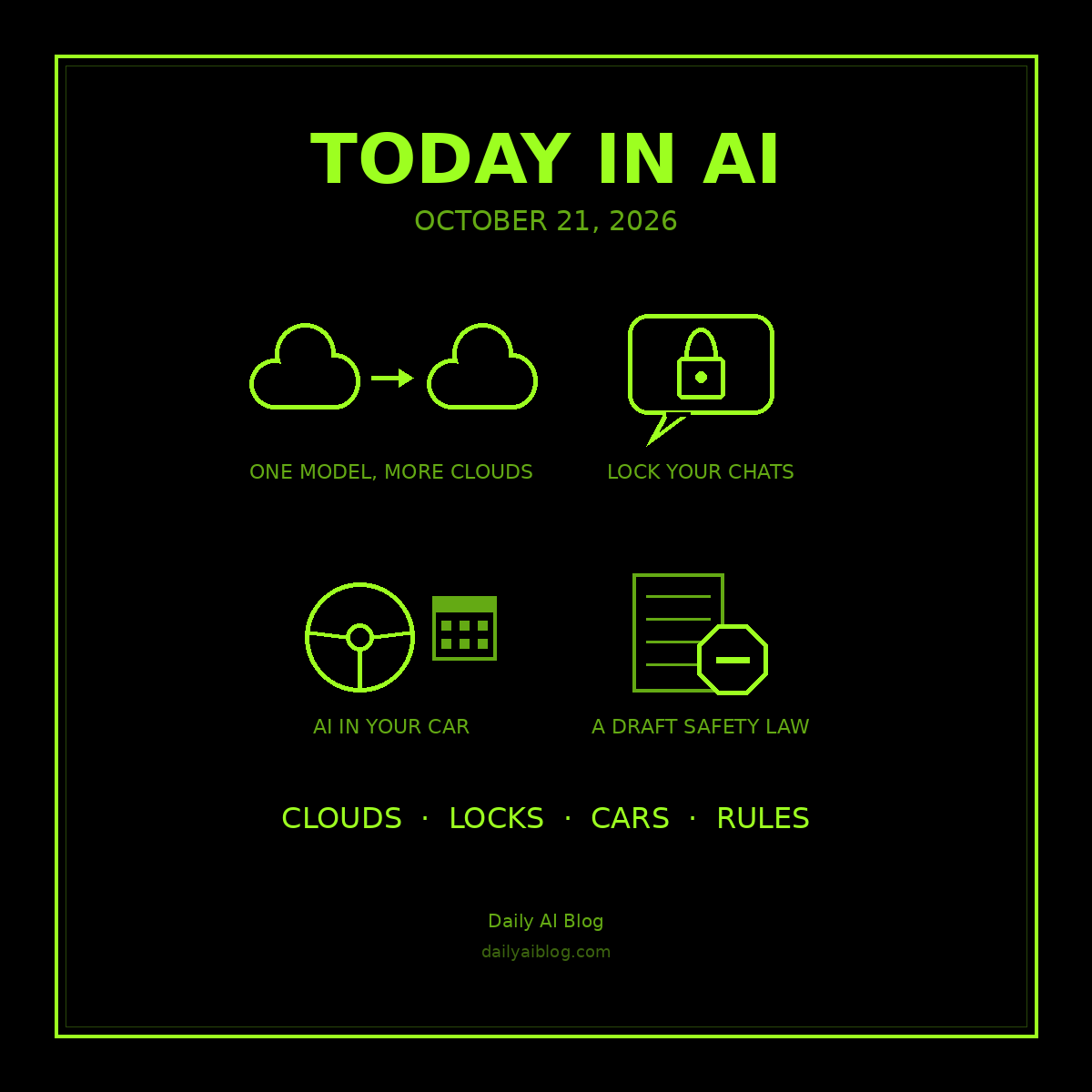
Wednesday’s AI news is about where your AI lives and what it knows about you. OpenAI is putting its models inside Google’s cloud, a pairing that would have sounded strange a year ago. ChatGPT now lets you lock private chats behind a PIN or Face ID. Gemini is heading into your car with access to your email and calendar, if you say yes. And Anthropic has a draft law for when a risky AI model should be stopped. Here’s what each one means for you.
1. OpenAI’s models are coming to Google Cloud
OpenAI and Google Cloud announced today that OpenAI’s frontier models and Codex agent workflows are coming to Model Garden, Google Cloud’s catalog of AI models. Google Cloud customers will be able to buy OpenAI models through the Google Cloud Marketplace, and companies with Google Cloud spending commitments can count those purchases against them. OpenAI also says its models will “soon” show up in Google Antigravity, Google’s coding tool, and in the Gemini Agent. General availability is planned “in the coming weeks.”
The two companies are direct rivals, which is what makes this interesting. CNBC notes that the deal puts OpenAI’s models on all three of the big U.S. cloud platforms. Amazon started hosting them in April, after Microsoft’s exclusive license ended. OpenAI’s post still says Microsoft “remains OpenAI’s primary cloud partner.”
Why it matters: the walls between AI ecosystems keep coming down. You’re less likely to be stuck with one company’s model just because of which cloud, office suite, or coding tool you picked.
Takeaway: if your business already pays for Google Cloud or Google tools, you may soon be able to test OpenAI models without signing a new contract. Don’t switch just because you can. Run the same real task, like a customer email or a product description, through two models and keep the one that does it better for less.
2. ChatGPT now lets you lock your private chats
OpenAI is rolling out locked chats, a way to hide selected conversations behind your 4-digit account PIN or your phone’s Face ID or Touch ID. To lock one, open the chat’s ••• menu and pick Lock chat. It then moves to its own Locked Chats section, out of your regular history, pinned chats, and search. OpenAI’s release notes say it’s rolling out gradually to Free, Go, Plus, and Pro users on the web, iOS, Android, and the ChatGPT desktop app.
Read the fine print, though. TechCrunch reports that locking a chat isn’t end-to-end encryption. It doesn’t change how long OpenAI keeps the chat, doesn’t erase anything ChatGPT remembered before you locked it, and doesn’t change your “Improve the model for everyone” setting. One big gotcha: resetting your PIN permanently deletes all your locked chats and their files.
Why it matters: lots of people now use ChatGPT for money, health, and family stuff, then hand their phone to a kid or open their laptop in a meeting. This is a lock on the drawer, not a safe.
Takeaway: lock chats about payroll, client problems, or personal matters if others can see your screen. But keep treating ChatGPT like a shared work tool. Don’t paste anything you wouldn’t want stored, and write down your PIN somewhere safe so a reset doesn’t wipe your locked chats.
Sources: ChatGPT release notes; TechCrunch.
3. Gemini rides along in your car, and it can read your calendar
Google is bringing Personal Intelligence with Gemini to the car. With your permission, it connects to Gmail, Google Calendar, Photos, Maps, YouTube, and Search, so you can just say “Take me to my doctor’s appointment” or ask “What’s my flight gate? And is my flight on time?” and get both answers at once.
It’s rolling out now on Android Auto and comes to cars with Google built-in over the coming months. It’s opt-in, and if you already turned it on in the Gemini app, it carries over to the car. Android Authority notes it’s limited to eligible personal Google accounts for users 18 and up, isn’t available in the EEA, Switzerland, the UK, or Nigeria, and doesn’t work with Workspace business accounts yet. TechCrunch points out the obvious tradeoff: it’s handy, and it also pulls you deeper into Google’s ecosystem.
Why it matters: fewer reasons to grab your phone while driving is a real safety win. But your car assistant now knows what’s in your inbox.
Takeaway: if you’re on the road a lot for work, like contractors, realtors, or delivery folks, try it with just Calendar and Maps connected first. You choose which apps Gemini can reach, so only add Gmail if you’re comfortable with it reading your email out loud with passengers around.
Sources: Google Blog; Android Authority; TechCrunch.
4. Anthropic drafts a law for stopping dangerous AI models
Anthropic has been shopping a draft AI safety bill to Congress, Politico reported, and TechCrunch summarizes the details. The bill would let a model’s release be blocked when there’s a “foreseeable, imminent risk” of more than 50 deaths or over a billion dollars in property damage, tied to a biological weapon, a cyberattack, or a model evading its developer’s controls. Those thresholds echo California’s recently passed SB 53.
Independent evaluators registered with the Commerce Department would test models. They could be paid by the AI labs, as long as payment doesn’t depend on the results. If they find an imminent catastrophic risk, they’d have 72 hours to alert Commerce, which would then have to ask a judge in Washington, D.C., to halt the release. No agency could stop a model on its own. An Anthropic spokesperson confirmed the draft to Politico, saying it reflects the company’s Advanced AI Framework.
Why it matters: this is an AI company proposing its own rules. TechCrunch flags the open question of how lab-paid evaluators stay neutral. Still, it goes further than some in the industry who argue no new laws are needed at all.
Takeaway: nothing changes for your tools today. But AI rules are being written right now, often by the companies being regulated. If you rely on AI for your business, it’s worth following the debate and telling your representatives what matters to you.
Source: TechCrunch (citing Politico).
The wrap-up
Today’s lesson: you get more choice about which AI you use, and you hand over more personal context to make it useful. Test models side by side instead of picking a team. Use locks and permissions, but know their limits. Connect only the apps you need. And keep an eye on who’s writing the rules, because they’ll shape the tools you use every day.
Share this article
Leave a Reply