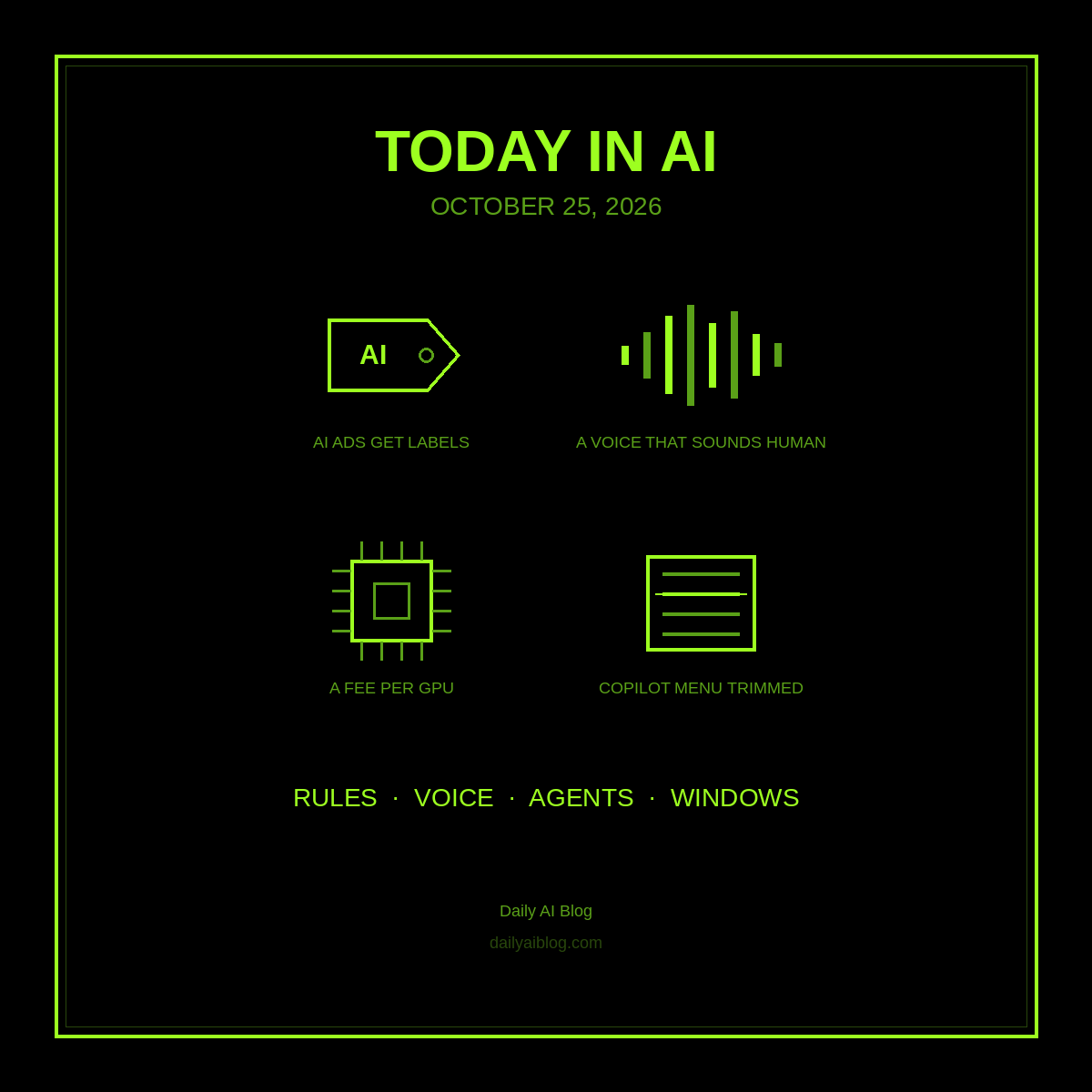
Sunday’s AI news is a good reminder that the rules around AI are getting written in real time. Pennsylvania just told advertisers they have to label AI-made ads. Block showed off a voice model that laughs, pauses, and sounds a little too human. Nvidia’s CEO floated a yearly software fee for every GPU that runs AI agents. And Microsoft is quietly trimming Copilot shortcuts out of the Windows right-click menu. Here’s what each one means for you.
1. Pennsylvania will make advertisers label AI-generated ads
Pennsylvania Governor Josh Shapiro signed the Artificial Intelligence Deceptive Advertising Act on Thursday, The Verge reports. CBS Pittsburgh calls it one of the first state laws of its kind, and it takes effect in 60 days, which law firm Loeb & Loeb puts at December 21, 2026.
The basics: if an ad uses images, video, or audio that were “significantly modified or generated” by AI in a way that could give buyers a false impression of a product, it needs a clear label saying so. Loeb & Loeb says the label has to show up the first time the content appears, in the same format as the ad, and be hard to remove where that’s technically possible. Content that’s obviously fictional, parody, satire, commentary, and text-only ads are exempt. Only the state attorney general and district attorneys can enforce it, with fines of up to $3,000 plus costs, and there’s no private right to sue.
Why it matters to you: The Verge points out the law applies no matter where the ad was made, so a business in another state running ads seen in Pennsylvania could be on the hook too. It also flags gray areas, like what counts as “significantly modified.” If you use AI product shots, AI voiceovers, or touched-up photos in your marketing, now’s a good time to make a simple rule for when you add a “made with AI” note. That’s general info, not legal advice, so check with a lawyer if you advertise heavily in Pennsylvania.
2. Block’s Dessa voice model laughs, pauses, and sounds eerily human
Jack Dorsey’s Block released Dessa, a voice model from its research lab, TechCrunch reports. It’s “full-duplex,” meaning it can listen and talk at the same time, the way people do on a phone call. According to Block’s Dessa page, it was trained only on human speech, with no text in the pipeline, and it can run locally on a MacBook Pro M4 Max or better.
Block’s pitch is that most voice AI turns your words into text and throws away everything text can’t carry, like tone and emotion. The demo clips show Dessa sounding tired, emotional, and playing a guessing game. The Verge describes it as talking “like an awkward new friend.”
Why it matters to you: You can’t use it yet. There’s no public access, and Block is giving early access to a small group of AI safety researchers first. TechCrunch notes Block sells tools to small businesses and Square already uses voice AI for ordering, so a voice model that runs on a device could eventually make phone ordering and customer service cheaper. The flip side is obvious: voices this real make scam calls harder to spot. A family code word or a quick call-back on a known number is still the best defense.
3. Nvidia floats a $2,000-per-GPU yearly fee for running AI agents
Nvidia CEO Jensen Huang said at GTC Berlin on October 22 that licensing the company’s software to “run agents on these AI factories” costs “about $2,000 per GPU per year,” Tom’s Hardware reports. He also said software licensing will become “increasingly a major part of our company’s business.”
Plenty is still unclear. Tom’s Hardware says Nvidia hasn’t said when that pricing would start, which software it covers, or how it fits with Nvidia AI Enterprise, which is listed at $4,500 per GPU for a one-year subscription. So don’t read it as a price cut. The talk came alongside Nvidia’s OpenShell reference architecture, a secure setup meant to fence AI agents in and quarantine one that steps out of bounds.
Why it matters to you: You’re not buying data center GPUs. But the companies behind the AI tools you pay for are, and software fees like this tend to roll downhill into subscription prices. It’s also another sign that the industry sees agents, AI that takes actions for you, as the next big business, and is building security around them.
4. Quick hit: Microsoft is pulling Copilot shortcuts from the Windows right-click menu
If you use OneDrive files in Windows 11, a few Copilot options are going away. In a Microsoft 365 message center notice, Microsoft says it’s retiring eight Copilot actions from the File Explorer right-click menu: Summarize, Create FAQ, Compare Files, Ask a question, Explain image, Explain images, Compare images, and Extract text. The Register covered the clear-out too.
Why it matters to you: Nothing’s really lost. Microsoft says you can still right-click a file and pick Ask Copilot, hover over a file in File Explorer Home and click the Copilot icon, or use the OneDrive activity center. The change starts rolling out in mid-November and should be done by early December. If you’ve written a how-to for your team that mentions those menu items, update it now.
The takeaway
AI is getting more convincing, and the guardrails are catching up one piece at a time. If you make marketing with AI, start labeling it. If you get a call that sounds just like someone you know asking for money, slow down and verify. And if a favorite AI shortcut moves, it usually just moved, not disappeared.
Sources
- The Verge: Pennsylvania will require labels on AI-generated ads
- Loeb & Loeb: What Pennsylvania’s AI disclosure law covers
- Pennsylvania SB 806 bill text
- Block: Dessa
- TechCrunch: Block’s new voice model sounds eerily human
- Tom’s Hardware: Nvidia discusses a $2,000-per-GPU annual software fee
- Microsoft 365 Message Center: Copilot actions in File Explorer being retired
Share this article
Leave a Reply