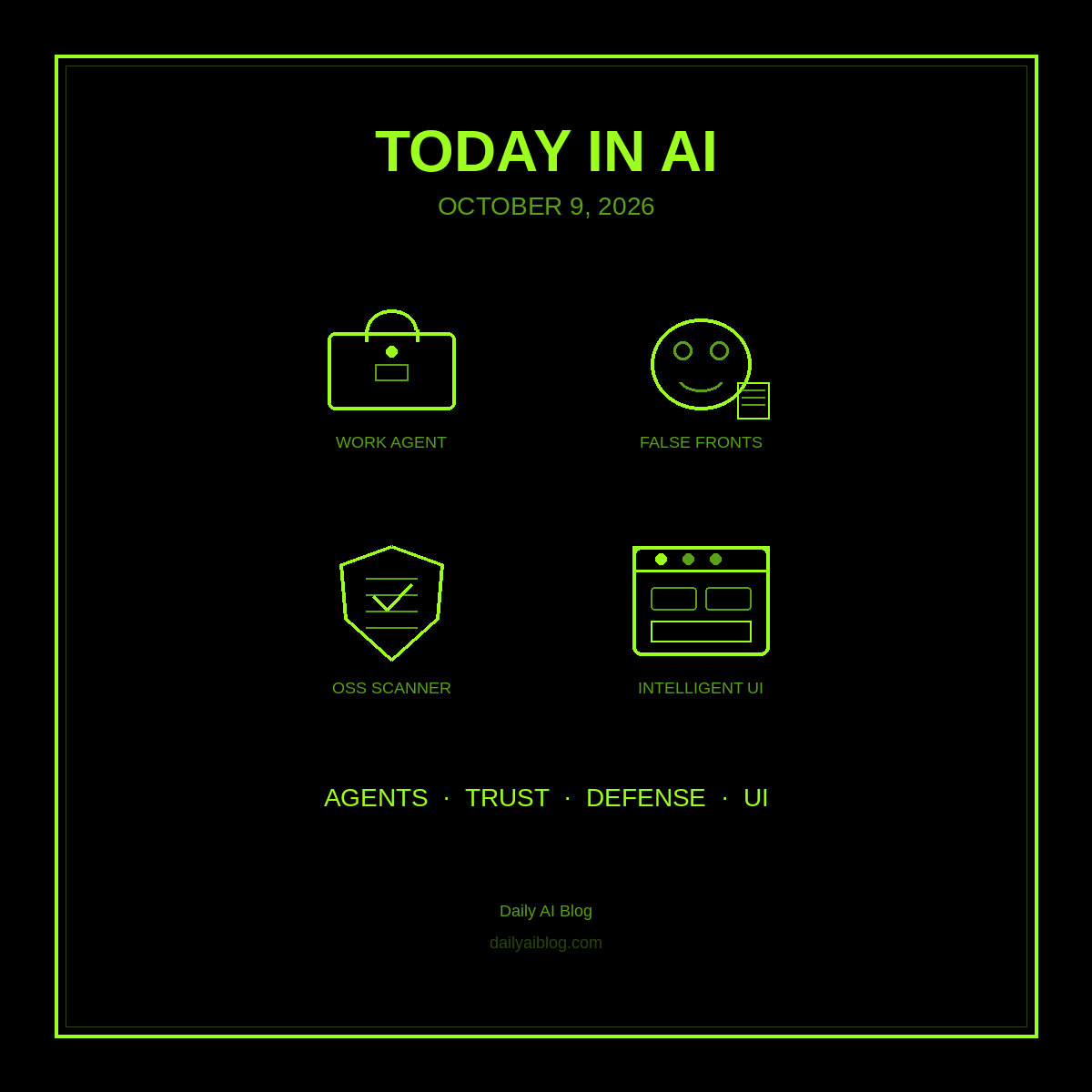
Friday’s stack is about agents that do real work, and the trust problems that come with powerful AI. Google Cloud launched a “universal agent for work” that can plan tasks and plug into the tools your company already uses. OpenAI banned two influence campaigns that used ChatGPT to run fake think tanks and journalist bylines. Anthropic opened a free vulnerability scanner for open-source projects. And GPT-6 with Interactive UI is rolling out to everyone in ChatGPT.
1. Google Cloud launches Gemini agent as a “universal agent for work”
At Gemini at Work 2026 on Thursday, Google Cloud announced the Gemini agent: a single agent meant to plan work, use skills and tools, connect to business systems, and bring finished results back into the documents, inbox, and developer environments people already use.
By default it picks the best model for the job. Users can also choose models themselves, including Anthropic’s Claude, with open-source and other private models planned later. It connects to Google Workspace, Microsoft 365, Slack, Jira, Confluence, Git, BigQuery, Databricks, Postgres, Snowflake, and MCP servers inside or outside the company network, according to TechCrunch.
A “tasks inbox” shows its thinking, subagents, skills, and progress. The agent can get its own Workspace account and email, with an audit trail attributed to the agent rather than a person. Access spans iOS and Android, Windows and Mac, the CLI, Workspace, Microsoft 365, ServiceNow, and Slack. Early testers include On, Shopify, and PayPal. Sundar Pichai said Gemini has over 1 billion monthly active users, and nearly 90% of Fortune 100 companies use Gemini Enterprise.
Google also announced new spend controls, including multi-model routing and real-time spend caps. 9to5Google reports the agent is in private preview now, with wider availability coming soon for select Workspace Business and Enterprise plans. No public price or general-availability date was given.
Why it matters: if your company already lives in Workspace or Microsoft 365, this is the kind of agent that could draft the deck, chase the calendar, and leave a paper trail. Treat it like a new teammate with permissions: start narrow, watch the audit log, and set spend caps before you let it roam.
Sources: Google (Oct. 8, 2026); TechCrunch; 9to5Google.
2. OpenAI disrupts Russia and Iran “false front” influence ops
OpenAI published a report Thursday on two covert influence operations it banned: a Russia-origin cluster nicknamed “Dark Clark,” and an Iran-origin cluster nicknamed “Bogus Bylines.” Both used ChatGPT alongside older false-front tricks to push geopolitical messaging into real audiences.
Dark Clark ran a fake “Social Research Center” in Latin America, with a persona named Mia Clark and what OpenAI says were unwitting local employees. Operators used ChatGPT mainly for internal reports. OpenAI rates it Category 5 on the IO Breakout Scale, the first Cat 5 operation it has disrupted. Some of the fakes were fact-checked or drew comment from politicians.
Bogus Bylines used seven fake journalist bylines to pitch about 100 articles to roughly a dozen small and medium outlets between July 2025 and October 2026, mostly on the US-Iran conflict. It also generated batches of social comments that got little engagement. OpenAI rates the article stream Category 4. NPR covers the same findings for a wider audience.
OpenAI’s point is practical: AI made old-style false fronts easier with fluency and scale, but exposure still disrupts them.
Why it matters: be skeptical of unfamiliar bylines and shiny new “think tanks,” especially when a small outlet is sitting on a hot conflict story. If you edit or publish online, verify who is pitching you before you hit publish. AI-polished English is not proof of a real reporter.
Sources: OpenAI (Oct. 8, 2026); NPR.
3. Anthropic launches a free OSS vulnerability scanner
Anthropic launched OSS Scanner on Thursday: a free, opt-in vulnerability-finding service for open-source projects, informed by Project Glasswing. Claude Security remains the paid enterprise product. OSS Scanner is the free track for eligible open-source maintainers.
Reports are model-generated with no human review, so they can be wrong. Anthropic says they come from its strongest models, including Claude Mythos, and typically include a reproducer, an explanation, and a candidate patch when one is available. Early feedback quoted from maintainers at PostgreSQL, OpenSSL, wolfSSL, HotCRP, and curl was broadly positive about signal quality.
In a validation pass, pen testers checked 97 critical and high findings across 48 projects: 85 (88%) met Anthropic’s coordinated disclosure bar, and only one was invalid. Maintainers enroll via a PR to Anthropic’s GitHub repo. Eligibility is similar to OSS-Fuzz: critical infrastructure impact, decided case by case.
Why it matters: if you maintain critical open-source code, this is a free second set of eyes, not a magic shield. Expect some noise, verify every report, and still run your normal review process. If you build on top of those projects, watch their security mailing lists: more high-quality findings may start landing faster.
Sources: Anthropic (Oct. 8, 2026).
4. GPT-6 and Intelligent UI roll out to everyone
OpenAI announced Wednesday that GPT-6 with Intelligent UI is rolling out in the Chat tab: Plus, Pro, Business, and Enterprise starting October 7, with Free and Go starting the next day (October 8). Enterprise access still depends on admin settings.
Intelligent UI means answers can include graphics, buttons, forms, charts, and in-chat tools, not just text. Paid tiers use GPT-6 Sol; Free and Go use GPT-6 Luna. Work and Codex models are unchanged. OpenAI says ChatGPT can start answering while it keeps thinking, and that search answers begin about 44% sooner on average versus GPT-5.6 Instant, per its own internal evaluation.
Why it matters: everyday ChatGPT users get a more visual, tool-like experience without waiting for a business plan. Try it for plans, comparisons, and quick calculators, then double-check anything that matters the old way.
Sources: OpenAI (Oct. 7, 2026).
Quick take for builders and small businesses
- Work agents: permissions, audit trails, and spend caps matter as much as the demos. Start with one narrow workflow.
- Influence ops: verify bylines and “research centers” before you amplify them. Small outlets are the soft target.
- OSS security: free scanners help, but maintainers still need humans to triage. Watch upstream advisories.
- ChatGPT UI: interactive answers are great for exploration. Keep a human in the loop for decisions that stick.
That’s Friday: a work agent from Google, two false-front campaigns named and banned, free vuln scans for open source, and GPT-6’s interactive UI for the rest of us. Stay curious, stay skeptical, and keep a human in the loop.
Share this article
Leave a Reply