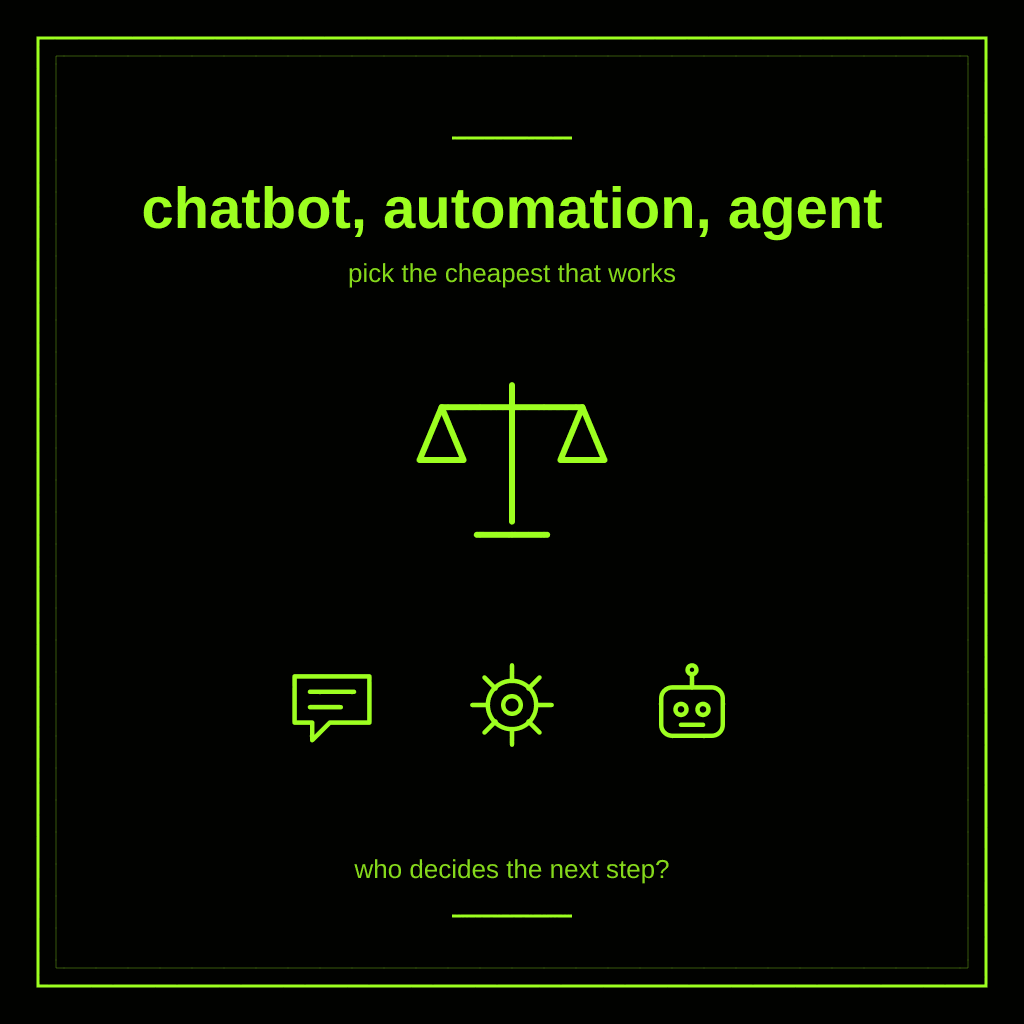
Half the “AI agent” pitches landing in small-business inboxes are selling an agent for a job a $30 automation — or a free chatbot — would do better. Here’s the three-way distinction in plain English, and a rule that will save you real money: buy the dumbest tool that completes the job.
By 2026, more than half of small businesses have adopted at least one AI-powered automation, and vendors have noticed: everything is now marketed as an “agent.” The word means something specific, and the price difference between the three tiers is enormous.
The three tiers, defined by one question
Who decides the next step?
- Chatbot: the customer decides. It answers questions — hours, pricing, order status, FAQs. It never acts on its own. Cheap or free, nearly risk-free, and it solves the single most common small-business gap: answering fast. (Our ten-minute customer-message workflow is this tier with zero software.)
- Automation: nobody decides — the steps are fixed. When X happens, do Y: new form entry → CRM row → welcome email → Slack ping. Make, Zapier, or your own tools’ built-ins. Utterly reliable because it can’t improvise. Most “we need an agent” requests are actually this.
- Agent: the software decides. Give it a goal — “qualify these leads and book the good ones” — and it plans steps, uses tools, reads replies, adapts. Genuinely powerful, genuinely newer, and the only tier where the failure mode is “it did something weird on its own.” This is the tier our Grok Bot series lives in.
Match the job to the tier
- Same questions all day? Chatbot. Done in an afternoon.
- Same steps all day? Automation. If you can write the steps on an index card, you don’t need an agent — you need the index card, executed reliably forever.
- Steps change based on judgment? Reading a lead’s reply and deciding the follow-up; researching a prospect before outreach; triaging an inbox into act/delegate/ignore — that’s agent work, because the path isn’t knowable in advance.
The money rule: each tier up costs roughly 10x more — in dollars, setup time, or supervision. An agent doing an automation’s job isn’t overkill, it’s a liability: you’re paying judgment prices for work that shouldn’t involve judgment, and judgment occasionally gets creative.
The hybrid most businesses actually want
The pattern that works: automation for the spine, agent for the judgment calls, human for the send button. The form intake, the record-keeping, the reminders — fixed steps, automated. The “is this lead worth a call?” decision — agent, in draft-and-approve mode, where it proposes and you click send. That draft-and-approve setup delivers most of the value at a fraction of the risk, and it’s exactly how we’ve structured every guide in the How to Have Grok Bot series.
Ready to buy something? Tomorrow’s post is the pre-purchase checklist: the six questions to ask before you sign up for any AI agent.
Related: How to Have Grok Bot Find Customers for You and the rest of the step-by-step agent guides.
Share this article
Leave a Reply