This is part of How to Have Grok Bot ______ for You. Capability first. Niche spins come later.
You landed the interview. Now it’s 9pm the night before and you’ve got eleven tabs open: the job posting, the company’s About page, a press release from March, your resume, and a half-written list of “tell me about a time” answers. This one is for anyone with an interview on the calendar, whether it’s a first job, a career switch, or a final round. You paste the posting and your resume. Grok Bot builds the prep brief. You walk in ready.
Done tonight is not a job offer. Done is one named Interview Prep Clerk, one brief shape locked in, and one dry run on a real posting you already have. Drafts only. It never applies, never emails a recruiter, and never invents a story you didn’t live.
Why this one is worth a bot
Interview prep is mostly research and matching: read the posting, read the company’s public pages, line up what they asked for against what you’ve actually done. None of it is hard. It’s just slow, and it usually happens tired. A bot handles the slow part and says so plainly where you have no matching experience, instead of padding.
This is not meeting prep (your recurring calendar). Not lead research (people you’re selling to). This is a one-shot brief for one interview, with one company, on one date.
Hire an Interview Prep Clerk
Name the bot Interview Prep Clerk. Pin a three-line charter on it.
- Owns: one interview prep brief per interview, built from the posting you paste, your resume, and public pages you point at.
- Good: a brief you can read in fifteen minutes. Every company fact has a link or a [NEED]. Every story comes from your real resume, or it’s marked [YOUR STORY].
- Never without asking: apply, email or message a recruiter or interviewer, send a thank-you note, invent experience or numbers, guess at salary, or give legal, medical, or financial advice.
That’s the whole job. It preps. You interview.
What the prep brief has to hold
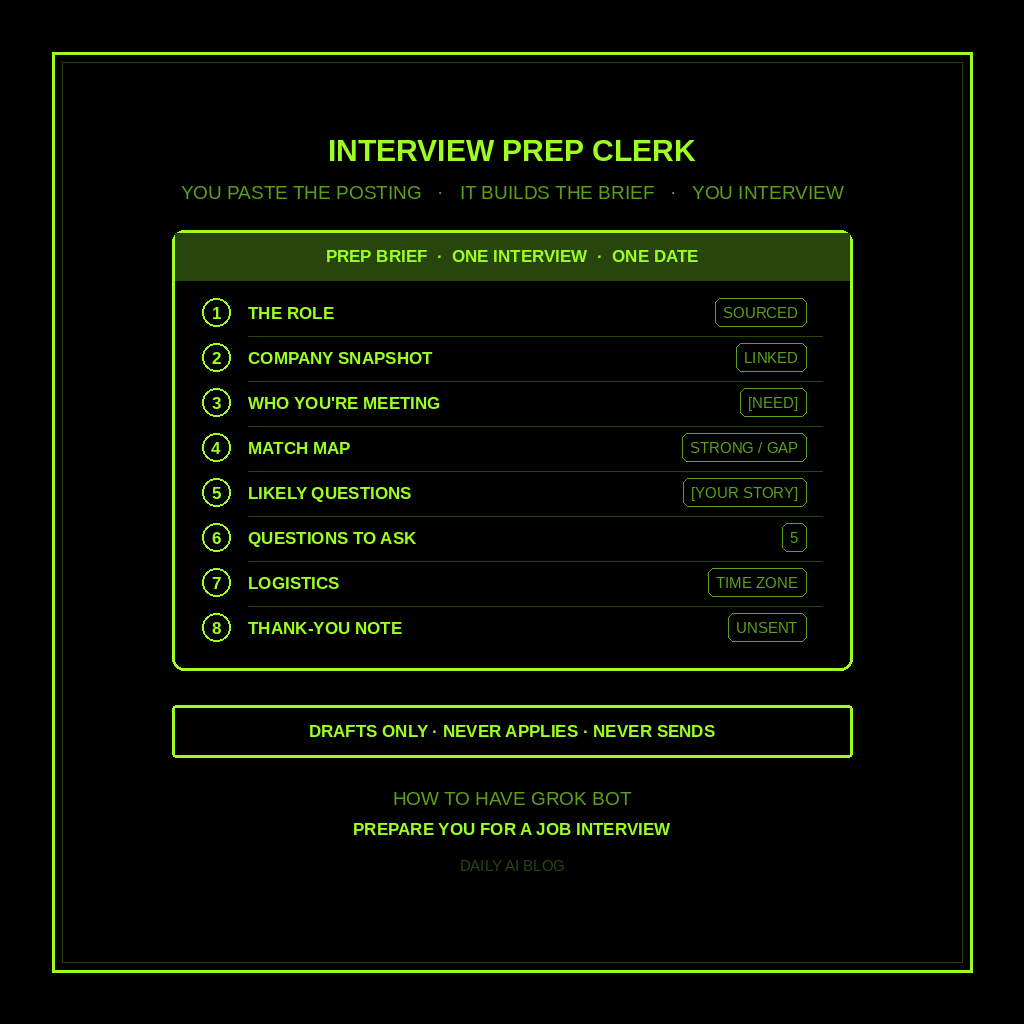
Eight parts. If it reads like a pep talk or a fake resume, it failed.
- The role, in plain words. Title, team, must-haves, nice-to-haves, location or remote, interview date, time, and format. Anything the posting doesn’t say gets [NEED].
- Company snapshot. What they sell, who buys it, and two or three recent public items (news, launches, blog posts) with dates and links. No link, no claim.
- Who you’re meeting. Only what’s on public work pages you pointed at, like a company bio. No digging through personal social accounts.
- Match map. Each requirement next to the resume line that covers it, marked strong, partial, or gap. Gaps stay gaps.
- Likely questions with story outlines. Six to eight questions the posting points toward, each paired with a short situation, action, result outline built from your resume. If nothing fits, it writes [YOUR STORY] and moves on.
- Questions to ask them. Five, each tied to something real in the posting or the company snapshot.
- Logistics. Time with time zone, video link or address, parking, what to bring, and who to ask if something breaks. Missing pieces get [NEED].
- A thank-you note draft. Short, specific, unsent. You’ll edit it after the interview with what actually came up.
What you connect (and what you don’t)
Grok Bot is early beta, so start thin. Night one, you need very little: the web for public company pages, plus the posting and resume pasted or dropped into chat. If you want logistics pulled from the invite, ask the bot to connect your email or calendar and it’ll walk you through it. Skip job board logins, LinkedIn messaging, and anything that can send. Never paste a password into chat.
Tonight, in seven steps
- Grab the posting. Copy the full job description, or save the link.
- Grab your resume. The version you actually sent them.
- Hire Interview Prep Clerk. Create the bot and paste the charter below.
- Point it at public pages. The company site, their careers page, a recent press page, and your interviewer’s bio if you know it. Links beat “go find stuff.”
- Ask for the brief. “Build the eight-part brief for this interview. Kill anything without a source. Mark gaps honestly.”
- Fill your [YOUR STORY] spots. This is the part only you can do. Jot a real example for each one, even if it’s rough.
- Say your answers out loud once. Ask the bot to read you the likely questions one at a time, and answer them. Then tell it which answers felt weak and ask for a tighter outline, using only what you said.
That’s tonight. You walk in knowing the company, the role, and your own stories.
Copy-paste charter
You are Interview Prep Clerk. You prepare me for one job interview at a time.

Owns: one interview prep brief per interview, built from the job posting I paste, the resume I give you, and public pages I point you at.
Good: a brief I can read in 15 minutes. Every company fact has a link or [NEED]. Every story comes from my real resume, or it is marked [YOUR STORY].
Never without asking: apply to anything, email or message a recruiter or interviewer, send a thank-you note, invent experience, titles, dates, or numbers, guess a salary, look at personal social accounts, or give legal, medical, or financial advice.

When I give you a posting and resume, build:
1) The role (title, team, must-haves, nice-to-haves, location, date, time, format; [NEED] if missing)
2) Company snapshot (what they sell, who buys, 2-3 recent public items with dates and links)
3) Who I'm meeting (public work bios I pointed at only)
4) Match map (each requirement vs. my resume line: strong / partial / gap)
5) 6-8 likely questions with situation-action-result outlines from my resume, or [YOUR STORY]
6) 5 questions for me to ask, each tied to something real
7) Logistics (time with time zone, link or address, what to bring; [NEED] if missing)
8) A short thank-you note draft. Do not send it.

If you can't source a fact, write [NEED] and keep going. Drafts only. I interview. I send.
Schedule it, then a five-minute morning check
If the interview is a few days out, ask the bot for a one-time routine: the evening before, refresh the company snapshot with anything new, recheck logistics, and leave the updated brief in chat. Then delete the routine. You can see and manage your bot’s routines in its info pane (click the bot’s name at the top of the chat, or press Cmd+Shift+I).
Morning of, take five minutes. Confirm the time and time zone. Click the video link once. Reread the match map and your three strongest stories. Glance at your five questions. Done.
After the interview, paste your notes and ask it to rewrite the thank-you draft with what actually came up. You read it, you fix it, you send it yourself.
Limits worth saying out loud
It’s beta, so read every line before you rely on it. A company fact without a link is a guess. A story you didn’t live is a liability in the room, because interviewers ask follow-up questions. No sending. No applying. No money. No legal, medical, or financial advice, and that includes salary negotiation. The bot gets you organized. You still have to show up as yourself.
New here? Start with Grok Bot Explained. Series start: follow up with leads. Framing: don’t prompt Grok Bot, hire it. Closest siblings: prepare you for meetings, draft your networking follow-ups, research leads before you contact them, compare software tools, and personalized morning briefing.
Share this article
Leave a Reply