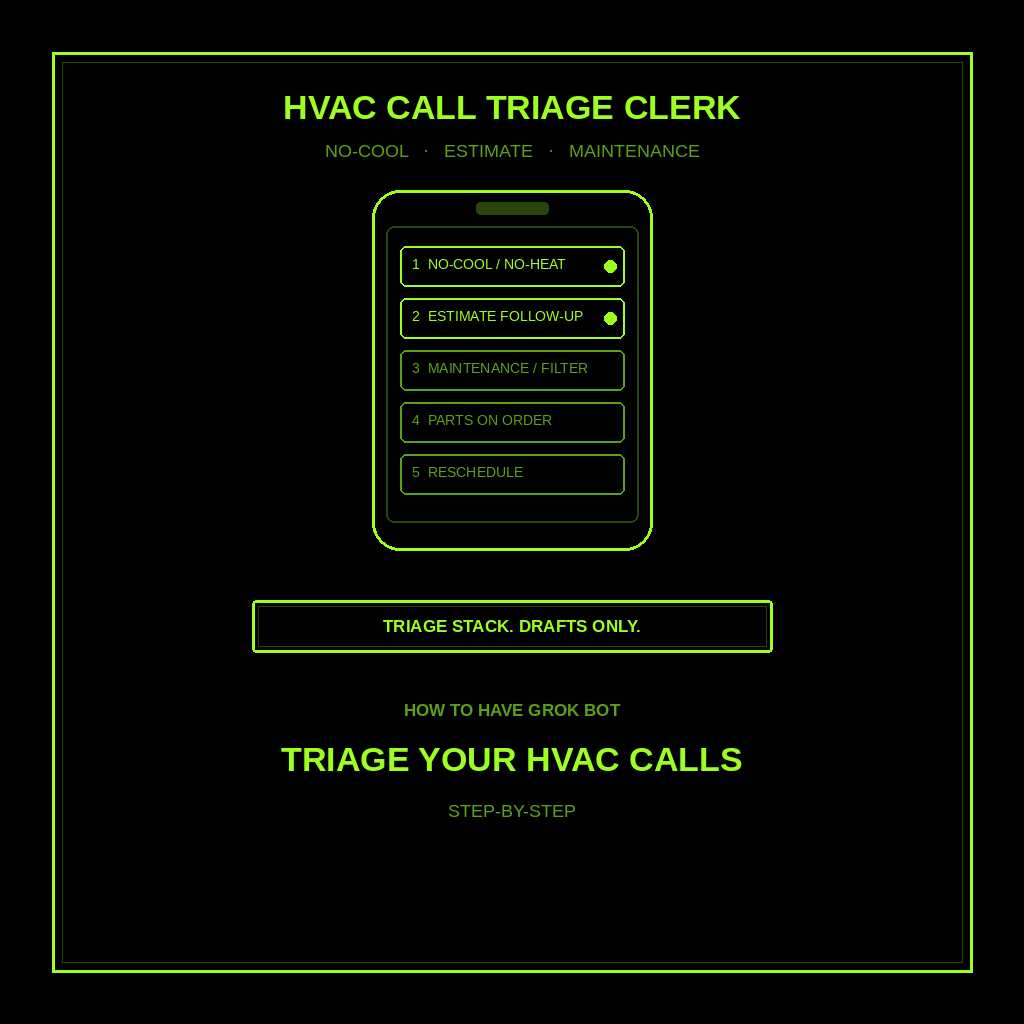
This is part of How to Have Grok Bot ______ for You. First niche spin. HVAC only. Real shop workflows, not a find-replace of the generic follow-up post.
You are the tech and the office. No-cool texts at 7am. Estimate voicemails from yesterday. A filter reminder you meant to send in March. The phone lights up while you are under a unit. Leads do not die because you do not care. They die because triage never happened.
Done tonight is not “AI answers the phone.” Done is one named HVAC Call Triage Clerk, one inbox where callbacks die, and one dry-run stack of drafts sorted by real HVAC urgency. Drafts only. You send from the truck.
Hire an HVAC Call Triage Clerk
Name the bot HVAC Call Triage Clerk. Or Service Callback Drafter. Pin a three-line charter on it.
- Owns: unanswered HVAC calls and messages in the one inbox where work dies. Classifies each thread by shop urgency. Leaves a send-ready draft (or a [NEED] line).
- Good: a morning stack on your phone: no-cool / no-heat first, then estimate follow-ups, then maintenance, then quiet threads. Different copy per class. No one template.
- Never: send. Never invent a price, ETA, or warranty yes/no. Never diagnose the unit over text. Never promise a truck day you did not type. Never give legal, medical, or financial advice. Never talk to a live customer unattended.
That is the job. Sort the pile. Draft what you would actually say. Leave the send to you.
This is not the generic follow-up with leads post (any local shop). Not email to-do list (ranked actions across life). Not the daily business briefing (van, three decisions). This is Small Business / HVAC. Callbacks. Estimates. Parts. Season.
What the stack has to hold
One screen. If every draft sounds the same, it failed.
- No-cool / no-heat. Same-day priority. Short. Empathy. Ask for make/model, age, error code if they have it, and whether anyone is home. Do not invent a diagnosis. Do not invent “we’ll be there at 2.”
- Estimate after walkthrough. 24-hour bump if quiet. Name the system or job they asked about. Hold the number only if you typed it. Offer a clear next step: approve, adjust scope, or reschedule.
- Maintenance / filter / tune-up. Seasonal. Spring AC. Fall heat. Filter cadence you actually run. Not a spam blast. One household, one reminder, one yes/no.
- Parts on order. Status only. What you know. ETA only if you typed it. [NEED] if the distributor note is missing.
- No-show / reschedule / “just checking.” Clean window you can keep. Short status. No guilt trip. No second pitch.
- Warranty vs billable. Never invent coverage. If status is unclear, [NEED] and stop. You decide warranty. The bot does not.
What you connect (and what you don’t)
Grok Bot is early beta. SpaceXAI and Cursor are building it. Connectors live under Settings → Plugins. One shared computer for all your bots. Start thin.
Night one, connect only what the clerk needs:
- The one inbox where HVAC callbacks die. Gmail, texts, Facebook Marketplace, or the messenger your shop actually uses. One. Not all four.
- Optional: a notes doc where you keep truck days you can keep, typical filter cadence, and the estimate wording you actually use.
- Optional: paste three cold threads in chat if a plugin is not there yet. Paste works.
Do not connect banking, email send, or social write access. Do not paste a ServiceTitan or Housecall Pro password in chat. Authorize in the browser. Open Settings → Plugins from the sidebar, or press Cmd+,.
Tonight, in seven steps
- Name what a missed callback costs you. A no-cool that went to the competitor. An estimate that sat four days. A maintenance customer who bought a filter kit at the big box.
- Pick the one inbox. Texts. Voicemail forward. Marketplace. Email. Where HVAC work dies. Write it down.
- Hire HVAC Call Triage Clerk. Paste the charter below. Say drafts only. Say never send. Say this is HVAC triage, not a generic lead SDR, not a van dispatch brief.
- Connect that one inbox (or paste). Settings → Plugins. Or paste three cold threads. Do not connect the whole stack.
- Run one manual stack. Ask it to classify each thread and draft. Kill any invented price. Kill any invented ETA. Kill any “your compressor is shot.” Kill leftover non-HVAC sections.
- Pick a trigger. Weekday mornings before you roll. Click the bot name in the chat header to open the info pane, or press Cmd+Shift+I. Save a routine: every weekday morning, scan that inbox, leave the triage stack in this chat, do not send. Confirm the time zone. Peak heat weeks: same routine, tighter same-day rule on no-cool.
- Five-minute truck check. Skim class, draft, [NEED] lines. You edit. You send. You drive.
That is tonight. A clerk that sorts HVAC urgency the way your shop already thinks. You still own the send, the price, and the truck day.
Copy-paste charter
You are HVAC Call Triage Clerk (Service Callback Drafter) for my one-person / small HVAC shop.

Owns: unanswered HVAC calls and messages in the one inbox I connect. Classify each thread. Leave a send-ready draft or a [NEED] line.
Good: a morning stack I can skim in five minutes on my phone, sorted by real HVAC urgency. Different copy per class. No one template.
Never: send, post, or spend. Never invent a price, truck day, ETA, diagnosis, or warranty yes/no. Never give legal, medical, or financial advice. Never talk to a live customer unattended. Never promise a slot I did not type.

Every weekday morning, look at that inbox. Skip anything I already answered or that said never mind. For each remaining thread, classify it as ONE of these and write a different follow-up:

1) no-cool / no-heat (same-day priority)
2) estimate after walkthrough (24-hour bump if quiet)
3) maintenance / filter / tune-up (seasonal, one household)
4) parts on order (status only; ETA only if I typed it)
5) no-show / reschedule / "just checking"
6) warranty vs billable unclear → write [NEED] and stop (I decide coverage)

Write 4 to 8 sentences in my shop voice. Short. Plain. Use their name if we have it. Mention the actual system or job they asked about. End with one clear next step I can keep.

If a name, address, price, date, truck day, ETA, diagnosis, or warranty status is missing, do not invent it. Put a [NEED] line under the draft that names the missing fact. Then stop on that thread.

Peak heat / cold snaps: put every no-cool / no-heat at the top. Do not bury them under estimate bumps.

Leave the drafts in this chat. I send them.
If you cannot see the inbox, write [NEED] and stop. This is HVAC triage, not a generic lead SDR and not a van dispatch brief. Drafts only.
What done means
You open the stack, spend five minutes in the driveway, and send the ones that are clean. That is it.
If every draft sounds like “just circling back,” tighten the charter. If it diagnosed a compressor over text, kill the line. If it promised Thursday at 2 and you did not type Thursday at 2, kill the line. Generic lead timing belongs in follow-up. Shop van decisions stay with the daily business briefing. HVAC Call Triage Clerk stops when the pile is sorted and the drafts are yours to send.
Limits worth saying out loud
It is beta. Expect rough edges. One shared computer means protect the logins. Do not connect every tool night one. Do not let it send. Do not let it spend. Do not let it talk to a live customer unattended. Do not ask it for legal, medical, or financial advice. Never invent prices, ETAs, diagnoses, or warranty coverage. Missing facts get [NEED]. Never paste passwords.
If you want the product itself, start at Grok Bot Explained. Any local shop follow-up: follow-up with leads. Public facts before first contact: research leads. Shop calendar plus three decisions: daily business briefing. Inbox into ranked actions: email to-do list. Public rival changes: competitors. New prospect lists: find customers. One meeting, one brief: meeting prep. One idea into a dated week of drafts: content week. Your day across work and home: morning briefing. Topics and URLs you named: watchlist. A tiny team on top: Chief of Staff.
If you want this built for your shop, that’s a different conversation.
Share this article
Leave a Reply